My final reflection

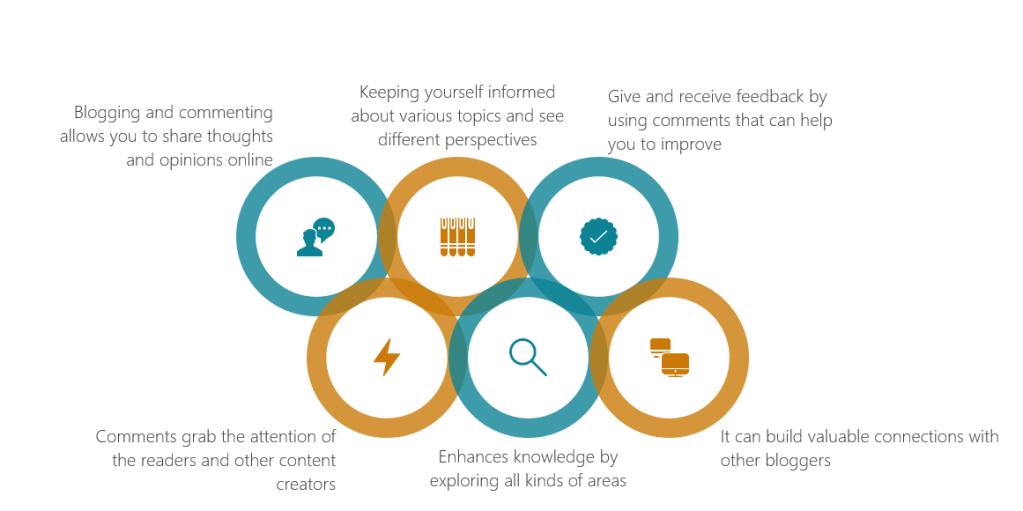
When I first choose this module, I was not quite sure what to expect. I had never comment on any blog before, not even to think about setting up my own. Reading blogs and posting comments, have not only given me insightful knowledge on various topics around digitalisation, but also many more advantages. I believe it is a great way to create a connection with people who share similar thoughts, but also an opportunity to see topics from a different perspective. I summarised my thoughts on blogging and commenting below:
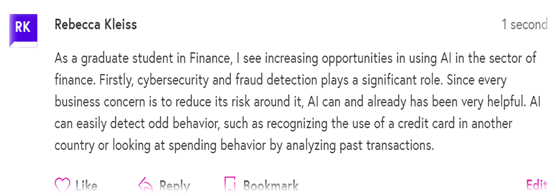
Since I am completing a master’s in finance, I mainly read blogs that sparked my interest and enhanced my knowledge in this area. I shared my thoughts in this regards to one article about the usage of Artificial Intelligence published on the future learning platform MOOC:
Digitalisation in the workplace

Further we discussed the impact of digitalisation on different job roles and its implications. I here found Kristy’s blog post on the changing role of a management accountant especially interesting. She makes a very good point by describing how the demand for accountants will decrease, but I also added my thoughts on the increasing importance of being able to manage and analyse big data here and in the spectrum of digital transformation in retail here.  

Report Highlights Widespread Shortcomings in Corporate Data Management
https://www.datanami.com/2019/06/28/report-highlights-widespread-shortcomings-in-corporate-data-management/

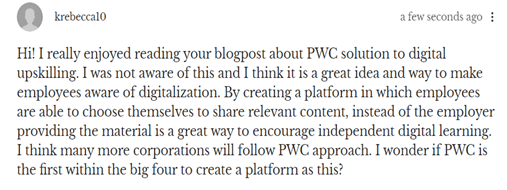
On the other hand, I found one great example by PWC on how employers can enhance digitalisation by engaging its employees on an internally created platform:  
»»——————————————————-—-««

“Music (either played from records or streamed from platform) remains a large part of our society and culture.”

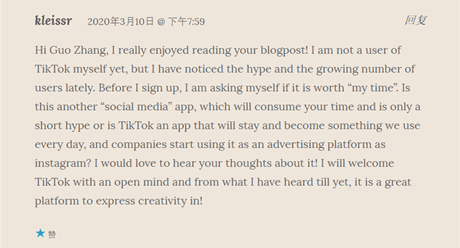
Besides reading content in topics of finance, the ongoing example of Spotify throughout the module was very interesting. I am a big fan of the music streaming platform and have been a customer since several years. Due to this module, I learned about Spotify’s digital business model, but also of new economic concepts such as the on-demand economy. Further I thought Tom’s thoughts on how digitalisation has affected musicians insightful. I realised that my freedom of being able to listen to music at anytime and anywhere has its downsides for the artists and shared my views here (user: kleissr). Moreover, I got the opportunity to read about the new viral content-making app TikTok and was able to engage by asking a question:
◣________________________________________________________◢

To conclude, it can be said that commenting is an effective tool to boost engagements on blogs. Comments serve several benefits, from grabbing the attention of the reader and other viewers, to providing the writer with feedback and appreciation. In my own case, I enjoyed receiving comments on my blog and see other students engaging in the same topic.

I now see blogging and sharing thoughts online as a tool to enhance learning, building better relationships online, and above all being digitally active.

The future of banking: Challenger banks

The previous post was all about how the financial sector is shifting towards a more tech-oriented perspective and how FinTech is changing the world of banking by creating more customer-centric products. It is not a secret that high street banking is not what it used to be, and in the last five years around 3,000 bank branches have closed their doors in the UK (KPMG, 2019). With fewer banks on the high street and a growing FinTech trend, the doors have been opened to new entrants- Challenger banks.

What is a challenger bank?

Challenger banks are smaller banks which set out their business model in combining technology and software to digitalise commercial banking. These banks are independent and challenge traditional banking by using digital distribution channels to deliver their services.

The services offered include the same as with any traditional bank, ranging from current accounts to insurance opportunities. The major difference can be found within that the transactions happen at real time and there exist no physical retail locations.

Want to open an account on a Sunday night from your bed?

In the past opening a bank account could be a painful process: a visit in the branch was necessary to fill out several forms and eventually receive the bank card in up to 10 working days. However, the big five digital-only banks Atom Bank, Monzo, Starling Bank, Revolut and N26 make it possible to create a bank account within only 15 minutes. All you need is your ID; a smartphone and an internet connection- and you will be all set up.

Besides setting up an account extremely fast, the new fintech banks offer other benefits such as charging low or no fees at all. This is possible due to the low operational costs a challenger bank faces in comparison to traditional banks. Since these banks have no branches, they operate with higher margins resulting in better rates for us- the costumer (Moneywise, 2019).

A success story: N26

(Cityam, 2020)

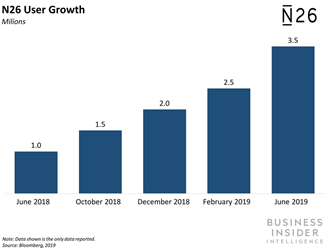
Being one of the most innovative and successful companies operating in the banking and finance industry today, N26 has gained more than 3.5 million customers in 24 European markets since its first launch in Germany in 2015. Today, their customers carry out 16 million transactions per month, which is around 400 transaction per minute (N26, 2019).

Founded by two Austrian entrepreneurs, N26 has its headquarter in Berlin, holds a full banking license and is one of the highest valued startups of Europe.

The company’s aim is “to become a full replacement for any other bank account in the markets we operate in” – CFO of N26 said (N26, 2019). The outlook is promising: in July 2019 the company was valued at $3.5 billion and their business is constantly expanding by entering new markets such as the US and Brazil (N26, 2020).

Is N26 as good as it sounds?

In my own opinion- yes! Being a customer of N26 myself I can highly relate to why challenger banks have become this popular and the rapid growing number of new customers. 

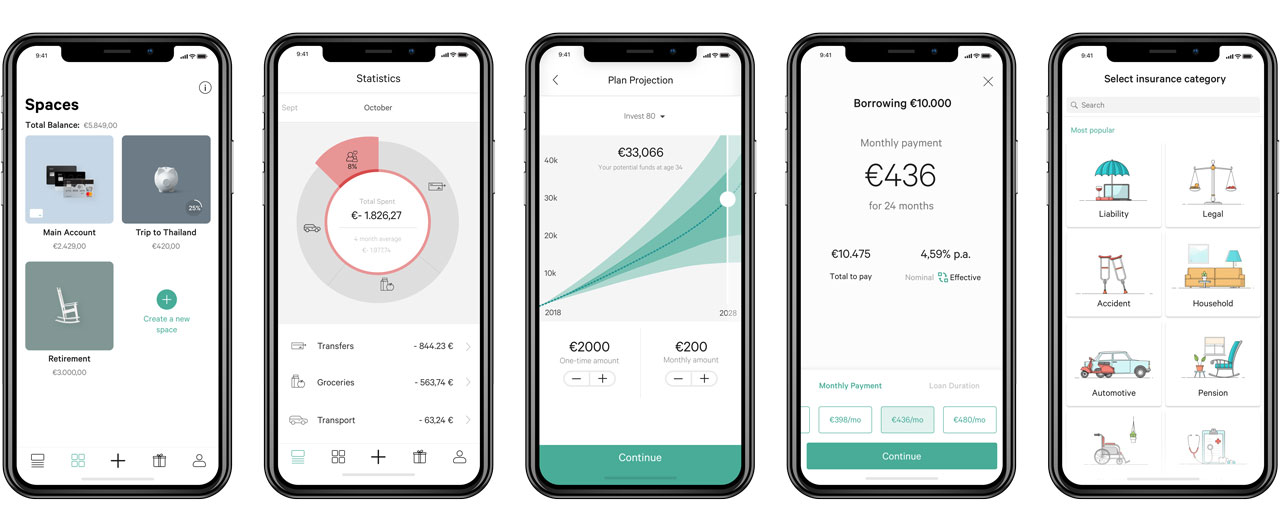
My own major benefits of using N26 consists of being able to manage my savings better by setting up “spaces”. Spaces are subaccounts of my main account and can be set up in seconds. Last year I planned a trip to Indonesia, I set up a new space called “travels”, transferred my savings and froze the account- all in three clicks in the N26 app. I was not able to access the account till the day my trip started and once it did, I set a limit of my daily budget to keep better track of my spending. Would this have been possible with my traditional bank? No.

Bildergebnis für n26 spaces
(Moneytoday, 2020)

A further benefit are the low fees and transaction costs. Since I have been living in Sweden, Germany, the Netherlands and am now a student in Exeter, the UK, I have bank accounts in each country. This meant high fees and transaction costs whenever I transferred or withdrew funds. However, with N26 I benefit from low transaction costs and am able to withdraw free fee-cash worldwide ten times a year.

Summed up

The success stories of N26 and other challenger banks demonstrate that banking can be truly digital by purely relying on an app. Nevertheless, there remain big challenges these new FinTech banks will face, including security and technical issues (Ozcan, 2019).

However, with their roots in technology, the growing number of invested funds and their quick ability to integrate new innovations, it can be expected that challenger banks will find their way.  

As a finance student pursuing a career in this industry, I am excited to be part of the rise of challenger banks and the types of updates and intelligent features we will see in the future!

References

Challenger Banks: Opportunities & Challenges. (2020). Retrieved 5 March 2020, from https://home.kpmg/uk/en/home/insights/2019/06/challenger-banks-opportunities-and-challenges.html

Challenger banks: the good, the bad and the different. (2020). Retrieved 5 March 2020, from https://www.moneywise.co.uk/savings/savings-accounts/challenger-banks-good-bad-different

Fintech Trends: Challenger Banking | finleap. (2020). Retrieved 5 March 2020, from https://www.finleap.com/insights/fintech-trends-challenger-banking/

Here’s how N26 is building a simple, flexible user-experience. (2020). Retrieved 5 March 2020, from https://n26.com/en-eu/blog/building-a-simple-flexible-banking-experience

Ozcan, P., Zachariadis, M., & Dinckol, D. (2019). “Platformification” of Banking: Strategy and challenges of challenger versus incumbent banks in UK. Academy Of Management Proceedings2019(1), 17147. doi: 10.5465/ambpp.2019.17147abstract 

The FinTech revolution

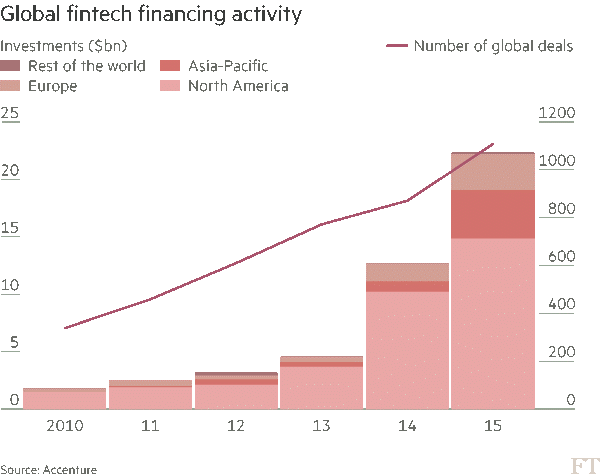
Several industries around the globe are facing the impacts of technological changes and the financial services industry is one of them. Consequently, the digital transformation in the sector of capital markets has even received its own term, called “FinTech”. FinTech refers to new technological innovations in financial services and has seen a rapid growth as the graph below shows (Forbes, 2020).

Chart: Global fintech activity

In this new digital era, banking has become faster and more convenient than ever. Not long ago, customers had to visit the bank itself or make long phone calls in order to transfer money or open a new account. Whereas invoices today can easily be paid online, money can be sent to individuals all over the globe and credit cards can be ordered by a few clicks on a smartphone.

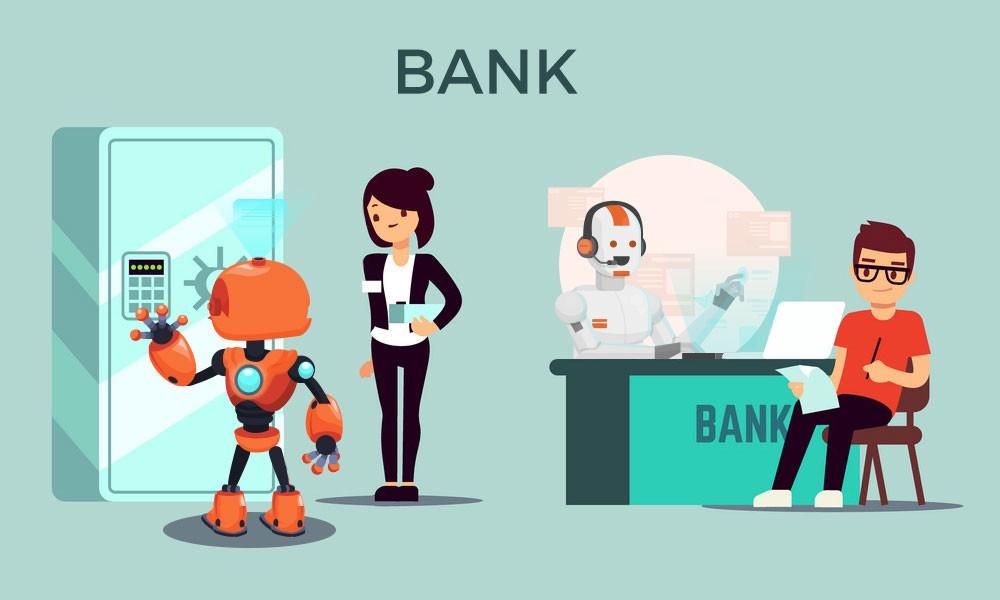
Taking a closer look on how processes have changed throughout technology, customer service is a great example. A good customer service is essential for any firm involved in finance. In the past, employees were trained in order to provide assistance for customers. However, technology has made it possible for customers to interact with the bank throughout chatbots. These chatbots are possible because of artificial intelligence and does not involve any human touch (Vatbox, 2020).

Has online banking evolved into being something essential in today’s world?

Banking was traditionally done in a non-virtual world, where customers would go to their bank and interact with staff to sort out their finances. Nowadays the possibilities to access bank accounts are endless and can be done via phones, tablets and computers. 

Lastly, fraud identification plays a significant role in the banking industry as well. It used to be a big effort for banks, since individuals had to investigate information to determine any potential fraudulent transactions. At present, artificial intelligence makes it possible to detect fraud and identify it in seconds. Systems are able to track previous patterns and hereby predict the likelihood of fraud.

The just mentioned examples are only a minor part of the improvements banks have seen through technology. In fact, outlooks suggest that the financial service sector is one of the industries that will face the highest changes in terms of digitalisation.

Specialised skills

Overall, it can be said that the transformation from banking into a digital space has had a positive impact on both firms and customers. As digitalisation overtakes the sector of financial services, so is the importance of specialised skills of staff increasing? Several banks acquire Fintech companies or reach out to consulting companies to support them in the integration of digitalisation in their future strategy.

When banking moves into more technological activities, the differentiation between financial services and technology becomes smaller. Traditional customer-facing jobs used to require a different skillset than considering the job of a banker at present. Artificial intelligence is replacing skills that are becoming irrelevant throughout this transformation and as a result banking and technology collide (efinancialcareers, 2020). This digital disruption in finance create new jobs, change existing jobs and some even disappear completely.

Since banks are aiming to automate work wherever they can, the number of traditional finance jobs are decreasing, whilst on the contrary new job roles are evolving. Financial institutions are in demand of highly technical skilled staff to maintain their integrated digital processes and to further exploit the opportunities it brings.

Future outlook

Since there is no end in sight of the ongoing revolution in financial services, HSBC even suggests a number of new jobs necessary to succeed in a digitally evolving financial industry. In the future, banks are on the hunt for staff with a digital mindset of skills, specialised in digital applications such as algorithmics and virtual reality (HSBC, 2020).

It cannot be denied that machines and artificial intelligence will continue to take on processes in the future, but the advantages of automation should not be underestimated. Instead, more emphasis should be set on human intelligence that include qualities such as empathy, curiosity and creativity.

In order for both financial institutions and employees to succeed in the future of a digital-enabled financial service industry, it is essential for employers to upskill their employees to prevent a shortage of skilled candidates. At the same time, employees must commit to lifelong learning and understand the importance of a digital mindset. 

References

10 Banking Trends For 2020: Stormy Weather Ahead. (2020). Retrieved 13 February 2020, from https://www.forbes.com/sites/alanmcintyre/2020/01/09/10-banking-trends-for-2020-stormy-weather-ahead/#1836bfd81c06

Banking and finance professionals must update their skills as the industry faces digital disruption. Retrieved 13 February 2020, from https://news.efinancialcareers.com/sg-en/3001122/banking-and-finance-professionals-must-update-their-skills-to-remain-competitive-as-the-industry-faces-digital-disruption-sc

How Technology Affects Jobs in the Financial Services Industry. (2020). Retrieved 13 February 2020, from https://vatbox.com/technology-affects-job-in-financial-industry/

HSBC highlights the six new banking careers of the future. (2020). Retrieved 14 February 2020, from https://www.finextra.com/newsarticle/32355/hsbc-highlights-the-six-new-banking-careers-of-the-future

This is me…

Hello everyone! My name is Rebecca and I am currently studying MSc. Finance and Marketing at University of Exeter. I am originally from Sweden, but grew up and studied in Stuttgart, Germany.

I choose this module since digitalisation plays a significant role in today’s business. Changes in digitalisation can be found in every field of business, and is very noticeable in the area of finance, especially in banking.

Design a site like this with WordPress.com
Get started